





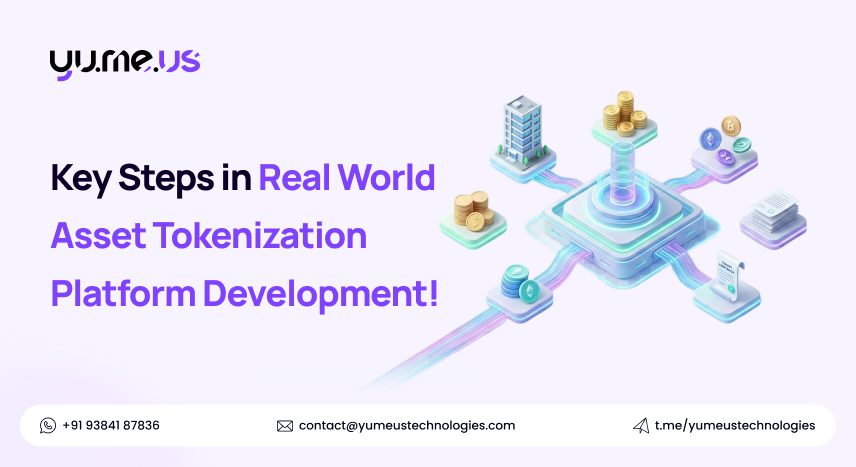
Key Steps in Real World Asset Tokenization Platform Development!

<p>Real World Asset Tokenization is revolutionizing investment in traditional assets such as real estate, commodities, and art. With thousands of new tokens issued every day, the process will scale faster than any company ever has: By digitizing physical assets through blockchain networks, companies can have liquidity, fractional ownership, and access to worldwide investors at an unrivaled pace. This revolution is more or less democratizing access to high-value assets that were previously restricted to institutions and ultra-wealthy individuals.</p><p>With the increasing demand for RWA tokenization platform development, comprehending the procedure is vital for organizations to gain a competitive edge. In this guide, we will cover what Real asset tokenization is, why businesses require real-world asset tokenization services, the advantages of such services, and the essential stages for the development of a solid platform that ensures compliance with regulations while satisfying market needs.</p><h2><strong>What is RWA Tokenization?</strong></h2><p>RWA tokenization translates into digitized representations of ownership rights to tangible or traditional assets, which get recorded on a blockchain as ledger-based native tokens. These tokens function as digital ownership certificates for anything of value, such as physical, digital, fungible, or non-fungible assets. Tokens may represent either full or fractional ownership of an asset, allowing the investor to buy fractions of expensive assets rather than needing to purchase them in their entirety.</p><p>Indeed, the DLT token mirrors the legal rights associated with the underlying asset through a structured vehicle such as an SPV, trust, or fund. It is by this process that the worlds of TradFi & DeFi are reconciled.</p><p>Real world assets’s include a wide variety of tangible and intangible assets. Assets such as residential and commercial real estate can be tokenized. Other types of assets that can be tokenized include commodities like gold, oil, and agricultural products. The next major category is financial instruments, including bonds, stocks, and derivatives. Moreover, intangible assets such as carbon credits, renewable energy certificates, and intellectual property rights are tokenized for easier tracking and trading.</p><h2><strong>Why Businesses Need Real World Asset Tokenization Services?</strong></h2><h3><strong>Unlocking Illiquid Asset Value</strong></h3><p>A big portion of the world’s wealth is still held in illiquid assets. In traditional markets, it is hard to extract value from something like real estate, private equity, or fine art without selling the entire asset. RWA Tokenization dApp development services solve this problem by creating liquid markets for otherwise illiquid holdings. The market for tokenized real estate alone is expected to reach USD 1.40 trillion by 2026, and BCG estimates the total size of all tokenized human assets could hit USD 16.10 trillion by 2030.</p><h3><strong>Global Market Reach</strong></h3><p>Tokenization removes geographical boundaries that limit opportunities for investment. A Brazilian with USD 1,000 can now invest in Manhattan property. Traders can now buy and sell assets without the friction of culture or geography with blockchain-based platforms that allow trading 24/7, free from time-zone restrictions. This simplified process also eliminates the need for dealing with third-party banking, which often charges high international transfer fees.</p><h3><strong>Reducing Transaction Costs and Time</strong></h3><p>Cost efficiency drives business adoption. Removing intermediaries and administrative overhead makes tokenization up to 65% cheaper than traditional securitization (35% if you avoid those costs by engaging in the traditional version). In the bond sector specifically, tokenization could lower issuance costs by up to 80%. Assuming adoption rates are high, the total cost-saving potential by 2030 is estimated at EUR 4.6 billion. Settlement times are reduced from days to minutes for near-real-time transactions.</p><h3><strong>Meeting Modern Investor Expectations</strong></h3><p>Overall, the market capitalization of tokenized real-world assets increased more than 260% in the first half of 2025, reaching a total value of over USD 23 billion, or an increase from roughly USD 8.6 billion. Investors are demanding liquidity, global accessibility, and programmability. Survey respondents cited democratized investment access (58%) and improved liquidity (61%) among the key benefits driving interest. Tokenized solutions serve a need that traditional business models overlook: mass affluent and digitally native investors who want portfolio diversification without needing significant amounts of initial capital will abandon irrelevance.</p><h2><strong>Benefits of Real World Assets Tokenization</strong></h2><h3><strong>Enhanced Liquidity for Traditional Assets</strong></h3><p>Tokenization transforms traditionally illiquid holdings into tradable digital units. Things such as real estate and fine art can now be traded on secondary markets like decentralized exchanges. This leads to a fluid ecosystem within the trading environment since investors respond in real time to developments in the markets. The Aspen coin represented the St. Regis Aspen Resort, allowing real estate investors to exchange their interests without having to wait for the entire property to be sold.</p><h3><strong>Fractional Ownership Opportunities</strong></h3><p>Tokenization also makes investments more accessible, as high-value assets can easily be divided into low-cost tokens. Instead of spending millions on a piece of art, an investor could purchase a token that represents a fraction for as little as USD 100.00. By tokenizing portions of its private equity fund, Hamilton Lane lowered the minimum investment from USD 5.00 million to only USD 20,000.00. This allows for diversification of the portfolio over multiple sectors and geographical regions.</p><h3><strong>Transparency Through Blockchain</strong></h3><p>Blockchain acts as an unalterable ledger, the ownership records and history are safely stored on it so that disputes and theft can be avoided. All transactions are publicly recorded on a ledger that participants are allowed to read/reference. Such transparency provides greater visibility into ownership structures and transaction history as well as asset provenance. For financial regulators, this translates into simpler auditing and compliance verification.</p><h3><strong>24/7 Trading Functionalities</strong></h3><p>These tokenized assets can transcend the limitations of traditional market hours, facilitating 24/7 onboarding, transfers, and settlement between overlapping global time zones. WisdomTree also introduced 24/7 trading with instant settlement for WTGXX, a stark contrast to the typical T+1 delays of conventional markets. Flow Traders offers institutional investors continuous proprietary, two-sided pricing for tokenized money-market funds, equities, and commodities.</p><h3><strong>Lower Entry Barriers for Investors</strong></h3><p>Tokenization democratizes access for retail investors in underdeveloped markets. A person in Bangkok could own a token representing one share of a building in the same city with just their smartphone and the internet. For example, platforms such as Lofty permit U.S. investors to own shares in rental properties starting from USD 50.00, allowing them to make daily rental income and trade their tokens instantaneously.</p><h3><strong>Automated Compliance and Reporting</strong></h3><p>Regulatory rules can be directly embedded into a token's code as smart contracts. This means the automation of compliance with guidelines such as anti-money laundering and know-your-customer checks, investor accreditation, and geographical constraints. Automated compliance reporting is a process of creating, verifying, and submitting regulatory reports programmatically using smart contracts and oracles. Some examples it will automate: compliance, whitelisting, transfer to a third party (escrow account), and corporate actions.</p><h2><strong>Steps in Real World Asset Tokenization Platform Development</strong></h2><p>Creating an enterprise-grade tokenization ecosystem that is responsible for managing billions of dollars of value may rightly be considered a huge project. To accomplish this, you need to put together the highly sophisticated web3 cryptography and the tightly framed legal system. Here are the fundamental steps that you should take to secure, scale, and make a portal compliant.</p><h3><strong>Step 1: Asset Selection, Valuation, and Strategic Structuring</strong></h3><p>Not every asset is the best candidate for tokenization! Some can be the best if chosen properly. The first is more legal than it is a technological challenge. It is a teamwork initiative that involves business strategists and legal professionals working closely together.</p><ul><li><p>The asset should be explicitly determined</p></li><li><p>The valuation should be based on independent assessments that provide aggressive estimates of total market value</p></li><li><p>It should be decided whether it will be fractionalized into equal shares</p></li><li><p>The economic advantages associated with the token need to be expressed in plain language.</p></li></ul><h3><strong>Step 2: Legal Frameworks and Ongoing Regulatory Compliance</strong></h3><p>Real-World Asset Tokenization is inseparably linked with intense regulatory scrutiny, especially from 2025 onwards. Depending on the specific territory, tokens that correspond to real-world assets are actually classified as security tokens in accordance with the law. Thus, you need to strictly follow the local financial regulations, which may include the fully implemented SEC guidelines in the USA or the mature MiCA framework that directly governs the EU in 2026. This important stage embraces the writing of legal wrappers, the legally binding setting up of Special Purpose Vehicles (SPVs) that will hold the underlying physical assets, and the dynamic, enforceable, and integrated compliance breaches that the smart contracts must execute.</p><h3><strong>Step 3: The Correct Selection of Blockchain Infrastructure Network</strong></h3><p>The core choice underlying the blockchain architecture is usually the salvo that either makes or breaks the adoption curve of a platform. While Ethereum is still the super champion of the game, backed by liquidity and standards such as ERC-3643 (which are objective standards for permissioned tokens), alternatives have widely penetrated the market by 2025 and 2026. Project networks based on blockchains like Polygon, specific for Avalanche Subnets, or institutional private chains have access to considerably greater transaction speed, near-zero fees, and complete grip on privacy in institutional cases. The secured network, carefully chosen, ought to be able to handle self-governing smart contracts that are both advanced and auditable.</p><h3><strong>Step 4: Planning the UI/UX and Overall Digital Platform</strong></h3><p>Successful tokenized marketplaces depend on a smooth user experience fairly free of direct interfaces. For example, it could happen that traditional investors are not acquainted with complex Web3 mechanics. Thus, the platform must really abstract these complexities.</p><p>The technological essentials include:</p><ul><li><p>The design of a user interface that is so natural</p></li><li><p>A bank platform that is fiat-to-crypto</p></li><li><p>Integrated KYC verification portals</p></li><li><p>The provision for absolutely neat portfolio data visualization.</p></li></ul><p>You just need to make sure of these things.</p><h3><strong>Step 5: Robust And Secure Audited Smart Contract Framework</strong></h3><p>Essentially, the contract is the unyielding technical heart of the whole business. Blockchain engineering teams must meticulously implement self-executing smart contracts to totally automate the token life cycle. These contracts must be constructed so as to exclusively secure tokens that are held or transferred only between wallets that have been properly verified and are on the strictly whitelisted list. Advanced built-in capabilities, such as distributing dividends in trusted stablecoins automatically, freezing tokens in the event of digital fraud, and bindingly forcing administrative transfers to retrieve lost wallet access quickly, all have to be unchanged and hard-coded directly into the digital asset.</p><h3><strong>Stage 6: Integration into the Platform and Comprehensive Security Check-Ups</strong></h3><p>After the core smart contract platform is constructed continuously, it rarely runs alone. It is required to securely communicate with a variety of external services. Decentralized Data Oracles, like Chainlink, are indeed crucially integrated for the seamless financing of real-time, reliable off-chain data onto the blockchain in a secure way. Apart from this, the security audits carried out by the various trustworthy third parties are both extremely intensive and a must-do to overcome the structural algorithmic vulnerabilities that can result in heavy capital loss through mathematical concepts.</p><h3><strong>Stage 7: Liquidity And Long-term Support after Launch</strong></h3><p>The platform would be launched and operationally developed with continuous promotional adverts and liquidity provision on decentralized exchanges, while keeping tabs on the technological configuration.</p><h2><strong>Features Of Real World Assets Tokenization Platform</strong></h2><h3><strong>Multi-Asset Support</strong></h3><p>To accommodate the various asset classes, a comprehensive real-world asset (RWA) tokenization platform should be capable of supporting multiple assets in one infrastructure. Robust platforms maintain security, scalability, and compliance provisions while enabling streamlining of investor participation. They allow for asset transfers across blockchain networks (multi-chain interoperability), addressing liquidity fragmentation.</p><h3><strong>KYC and AML Integration</strong></h3><p>Compliance begins with effective KYC systems and AML verification that ensure only legitimate users take part. In jurisdictions that require investors to be qualified, accreditation checks are made. With smart contracts, AML controls are built in for automatic validation of whether transactions relate to known corrupt activity. Before allowing a transaction to be approved, the approve function checks whether the spender and sender are on the KYC lists or blacklists.</p><h3><strong>Secure Wallet Infrastructure</strong></h3><p>Wallet systems supporting multi-signature controls and smart contract interactions are required at the platform level. Encrypted identity documents can be uploaded and stored securely for users.</p><h3><strong>Trading and Exchange Functionality</strong></h3><p>Order matching in real time allows for executing transactions quickly without using third parties. Transparent order books reveal open bids to all users, allowing them to make decisions.</p><h3><strong>Real-Time Asset Valuation</strong></h3><p>Oracle integrations retrieve live asset prices and valuations from trusted data providers. This allows for accurate valuations of tokenized assets and dynamic pricing in trading markets.</p><h3><strong>Reporting and Analytics Dashboard</strong></h3><p>For example, Automated Regulatory Reporting automatically collates data from on-chain transactions, off-chain records, and user activity to create reports that need to be submitted to bodies like FinCEN or FATF. A data ingestion layer with indexers and RPC nodes, processing engines, and reporting interfaces migrates compliance from manual processes straight to near real-time, auditable systems.</p><h2><strong>Why Choose Yumeus Technologies For Real World Asset Tokenization Platform Development?</strong></h2><h3><strong>Proven Expertise in Blockchain Solutions</strong></h3><p>As a market leader, Yumeus Technologies has established its footprint in 2025 as the best provider of large-scale and future-ready Real world asset tokenization platform development. They have established themselves as trusted advisors in enabling the transition of real-world assets into the crypto economy for both startups and enterprises, with precision and security. They provide multi-asset tokenization expertise, supporting real estate, commodities, equities, and alternative assets.</p><h3><strong>End-to-End Development Services</strong></h3><p>From ideation to deployment, Yumeus takes care of the entire Real world asset tokenization platform development lifecycle. This approach excludes the need to work with many vendors. Smart contract audits and advanced security frameworks underpin platform reliability, coupled with their enterprise-grade security.</p><h3><strong>Regulatory Compliance Knowledge</strong></h3><p>Their solutions comply with global regulations, a crucial aspect of Real world asset tokenization. This compliance-driven approach mitigates risk, hastens approvals, and cultivates confidence in regulators and investors. Regulatory adherence is not an afterthought but rather a fundamental practice.</p><h3><strong>Customizable Platform Features</strong></h3><p>Every platform, in contrast to generic templates, is custom-tailored to meet the needs of a particular business. This customization affords businesses the ability to tailor user experience, branding, and functionality around their unique value proposition. Scalability and flexibility ensure the platform grows with business demands.</p><h3><strong>Post-Launch Support and Maintenance </strong></h3><p>Ongoing support services assure smooth performance, security, and long-term success following the launch. Regular system updates safeguard against vulnerabilities, ensure compatibility with emerging technologies, and effectively address user feedback. This allows for the identification of issues that could arise in the future, hence maintaining the optimization and robustness of the functioning system.</p><h2><strong>Conclusion</strong></h2><p>Real-world asset tokenization is a groundbreaking change to the way in which people are able to access and trade valuable assets. By and large, the technology democratizes investment opportunities while reducing costs and settlement times by a huge margin. Finally, we’ve detailed the core steps to construct a compliant, secure platform that aligns with contemporary investor expectations. Select a development partner with reliable blockchain technology and regulatory experience to guarantee that the platform creates results. The revolution has begun in tokenization, and the ones who make their move first stand to gain a great competitive edge.</p>