





How Can a Polymarket Clone Script Solve Prediction Market Challenges?

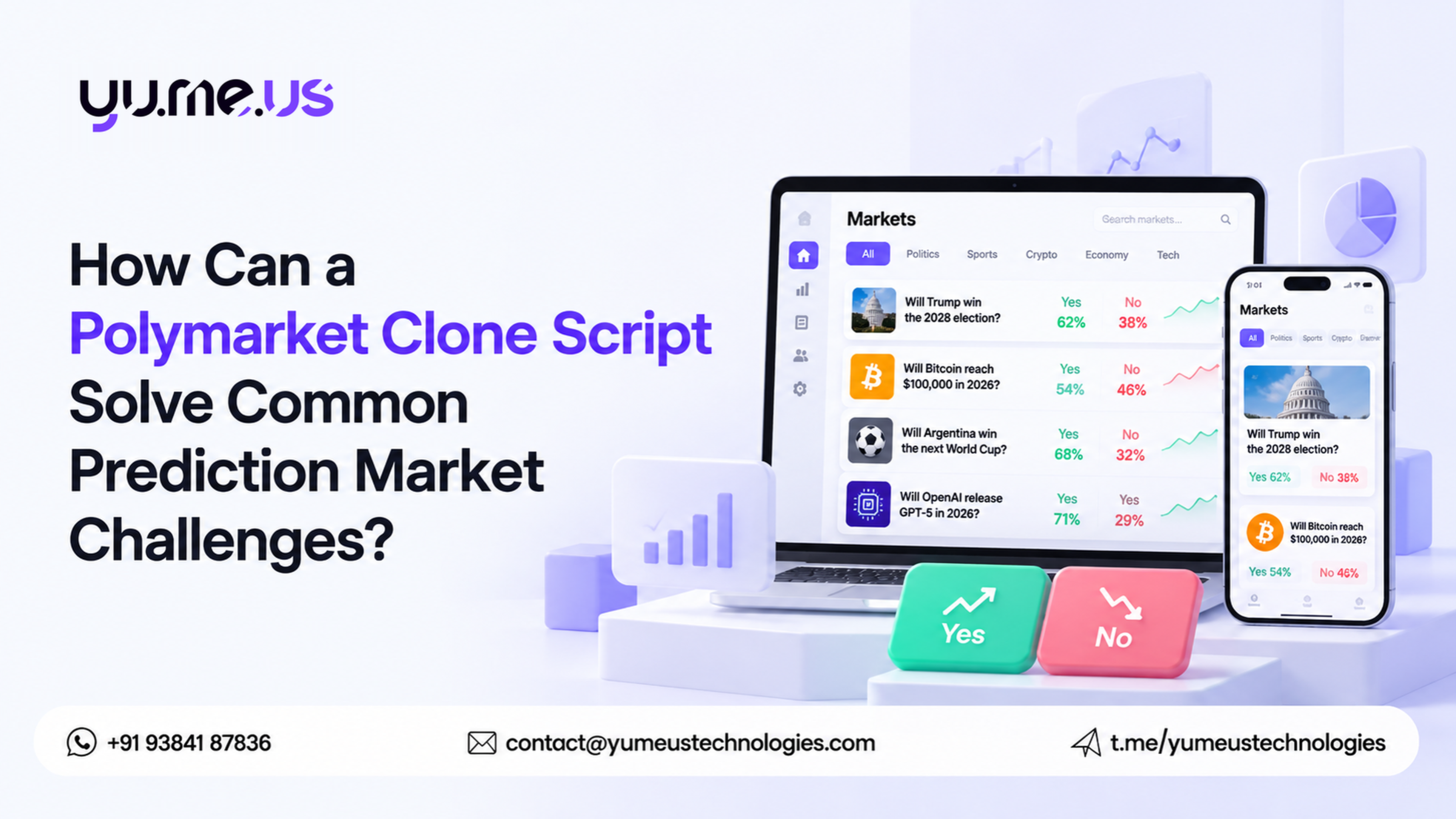
<h2><strong>Introduction</strong></h2><p>Prediction markets are gaining attention as businesses explore new opportunities in the blockchain ecosystem. However, launching a reliable platform involves several challenges, including security, liquidity, scalability, and user trust.</p><p>A Polymarket clone script can simplify the development process by providing reusable components for building a prediction market platform. With the right customization, businesses can create a branded solution that suits their goals and target audience.</p><p>At Yumeus Technologies, businesses can explore prediction market development options designed around their functional and technical requirements.</p><h2><strong>What Is a Polymarket Clone Script?</strong></h2><p>A <a target="_blank" rel="noopener noreferrer nofollow" class="" href="https://www.yumeustechnologies.com/blog/polymarket-clone-script">Polymarket clone script</a> is a software solution designed to help businesses build a prediction market platform with features similar to those found on Polymarket. Depending on the implementation, it can support market creation, user accounts, wallet integration, trading interfaces, and outcome settlement.</p><p>Instead of developing every component from scratch, businesses can use existing software modules as a starting point.</p><h3><strong>Key Benefits</strong></h3><ul><li><p>Faster development: Reusable components can reduce initial development effort.</p></li><li><p>Custom branding: Businesses can adapt the interface to their identity.</p></li><li><p>Flexible functionality: Features can be tailored to specific requirements.</p></li><li><p>Blockchain integration: Compatible networks and smart contracts can support decentralized operations.</p></li><li><p>Simplified maintenance: A well-structured solution can make future improvements easier.</p></li></ul><p>Therefore, a Polymarket clone script can provide a practical foundation for businesses entering the prediction market sector.</p><h2><strong>What Are the Common Challenges in Prediction Market Development?</strong></h2><p>Developing a prediction market involves more than creating an attractive interface. Businesses must address several technical and operational concerns before launching their platforms.</p><h3><strong>1. High Development Costs</strong></h3><p>Building a platform from scratch requires investment in design, development, blockchain integration, testing, and maintenance. Consequently, costs can increase when businesses need specialized functionality.</p><h3><strong>2. Security Vulnerabilities</strong></h3><p>Prediction markets may involve financial transactions and smart contracts. Coding errors, weak access controls, and insecure integrations can expose platforms to risks.</p><h3><strong>3. Limited Market Liquidity</strong></h3><p>A prediction market needs active participation to provide a useful trading experience. Without sufficient participants, users may struggle to find counterparties or execute trades at desirable prices.</p><h3><strong>4. Scalability Issues</strong></h3><p>As user activity increases, the platform must handle additional transactions and requests. Network congestion and inefficient architecture can affect performance.</p><h3><strong>5. User Trust and Transparency</strong></h3><p>Users need clear market rules, understandable settlement processes, and reliable outcome verification. Without these elements, attracting long-term participation becomes difficult.</p><p>Addressing these challenges early can help businesses create a more dependable platform.</p><h2><strong>How Can a Polymarket Clone Script Solve These Challenges?</strong></h2><p>A well-designed Polymarket clone script can reduce development complexity by providing a reusable software foundation. However, the final results depend on the quality of the code, customization, infrastructure, and security testing.</p><h3><strong>Reduce Development Complexity</strong></h3><p>Prebuilt modules can support essential functions such as user registration, market management, and dashboard operations. As a result, development teams can focus on business-specific requirements instead of rebuilding every component.</p><h3><strong>Strengthen Platform Security</strong></h3><p>Businesses can implement secure authentication, access controls, transaction monitoring, and smart contract testing. Independent security audits can provide additional assurance before deployment.</p><h3><strong>Improve the User Experience</strong></h3><p>A clear interface, simple navigation, and responsive design can help users understand markets and complete tasks more easily.</p><h3><strong>Support Future Growth</strong></h3><p>Modular architecture can make it easier to introduce new market categories, integrations, and platform features as requirements evolve.</p><p>For businesses seeking ready-to-deploy software for a prediction market, the important consideration is whether the solution supports their technical needs without compromising security or flexibility.</p><h2><strong>What Features Should a Polymarket Clone Platform Include?</strong></h2><p>The right feature set depends on the business model, target audience, blockchain network, and applicable regulations.</p><h3><strong>Essential Platform Features</strong></h3><ul><li><p>User registration and account management: Enable users to create and manage accounts.</p></li><li><p>Market creation: Allow authorized administrators to configure prediction markets and define their rules.</p></li><li><p>Market interface: Display available markets, prices, and relevant information.</p></li><li><p>Wallet integration: Support compatible wallets and secure transaction flows.</p></li><li><p>Smart contract integration: Automate supported operations according to tested contract logic.</p></li><li><p>Market resolution: Establish clear procedures for determining and settling outcomes.</p></li><li><p>Admin dashboard: Provide tools for managing users, markets, and platform activity.</p></li><li><p>Analytics and reporting: Help operators monitor engagement and platform performance.</p></li></ul><p>Additional features may include notifications, search filters, multilingual interfaces, and third-party data integrations.</p><p>Together, these capabilities can help businesses build a functional prediction market app that serves their intended audience.</p><h2><strong>How Does Blockchain Improve Transparency and Trust?</strong></h2><p>Blockchain technology can provide an auditable record of transactions and support automated execution through smart contracts. These capabilities can improve transparency when implemented correctly.</p><p>For example, a decentralized prediction market platform may use smart contracts to manage specified transactions and enforce predefined settlement conditions.</p><p>However, blockchain does not automatically guarantee accurate outcomes. External data sources, known as oracles, may introduce errors or delays. Therefore, businesses should establish reliable data verification, dispute-handling procedures, and clear settlement rules.</p><p>Security reviews are equally important. Smart contracts should be tested thoroughly before handling real transactions.</p><p>The goal is to combine transparent operations with dependable technical controls.</p><h2><strong>How Can Businesses Launch a Branded Polymarket-Style Prediction Market Platform?</strong></h2><p>A branded prediction market allows businesses to create a distinct user experience while using an existing software foundation.</p><p>A white-label solution may provide opportunities to customize:</p><ul><li><p>Brand identity: Logos, colors, typography, and interface design.</p></li><li><p>Market categories: Topics that suit the intended audience and comply with applicable laws.</p></li><li><p>Platform functionality: Features, dashboards, and administrative controls.</p></li><li><p>Integrations: Compatible wallets, data providers, and other services.</p></li><li><p>User experience: Navigation, onboarding, and market information.</p></li></ul><p>Businesses planning to launch a branded Polymarket-style prediction market platform should review the available customization options before choosing a vendor.</p><p>It is also important to assess source-code access, licensing terms, ongoing support, and ownership rights. These factors can influence long-term flexibility.</p><h2><strong>Why Choose Ready-to-Deploy Software for a Prediction Market?</strong></h2><p>Ready-to-deploy software can help businesses avoid some of the work involved in building every feature from the ground up. Nevertheless, the extent of the benefit depends on how complete and adaptable the software is.</p><h3><strong>Ready-to-Deploy Software vs. Custom Development</strong></h3><table style="min-width: 75px;"><colgroup><col style="min-width: 25px;"><col style="min-width: 25px;"><col style="min-width: 25px;"></colgroup><tbody><tr><th colspan="1" rowspan="1"><p><strong>Factor</strong></p></th><th colspan="1" rowspan="1"><p><strong>Ready-to-deploy software</strong></p></th><th colspan="1" rowspan="1"><p><strong>Custom development</strong></p></th></tr><tr><td colspan="1" rowspan="1"><p>Initial development</p></td><td colspan="1" rowspan="1"><p>Uses existing components</p></td><td colspan="1" rowspan="1"><p>Builds components around specific needs</p></td></tr><tr><td colspan="1" rowspan="1"><p>Customization</p></td><td colspan="1" rowspan="1"><p>Depends on software flexibility</p></td><td colspan="1" rowspan="1"><p>Can offer broader design control</p></td></tr><tr><td colspan="1" rowspan="1"><p>Time requirements</p></td><td colspan="1" rowspan="1"><p>May reduce initial development time</p></td><td colspan="1" rowspan="1"><p>Often requires more planning and implementation</p></td></tr><tr><td colspan="1" rowspan="1"><p>Initial investment</p></td><td colspan="1" rowspan="1"><p>May reduce some development costs</p></td><td colspan="1" rowspan="1"><p>Depends on complexity and scope</p></td></tr><tr><td colspan="1" rowspan="1"><p>Maintenance</p></td><td colspan="1" rowspan="1"><p>Depends on vendor support and code quality</p></td><td colspan="1" rowspan="1"><p>Depends on the development team</p></td></tr></tbody></table><p>Before buying a white-label Polymarket clone script, businesses should evaluate documentation, security practices, scalability, and integration capabilities.</p><p>A lower initial cost should not outweigh the need for dependable software.</p><h2><strong>How to Launch a Decentralized Prediction Market Platform Using a Polymarket Clone Script</strong></h2><p>Launching a platform requires a structured approach. The following steps can help businesses plan the process.</p><h3><strong>Step 1: Define Your Business Model</strong></h3><p>Identify your target users, market categories, revenue model, and core platform requirements.</p><h3><strong>Step 2: Select a Suitable Blockchain</strong></h3><p>Evaluate transaction fees, network performance, ecosystem support, and compatibility with the intended features.</p><h3><strong>Step 3: Customize the Platform</strong></h3><p>Adapt the design, market interfaces, administrative tools, and functionality to your business requirements.</p><h3><strong>Step 4: Integrate Wallets and Smart Contracts</strong></h3><p>Implement compatible wallet connections and thoroughly test transaction and settlement logic.</p><h3><strong>Step 5: Conduct Security Testing</strong></h3><p>Review the code, test common attack scenarios, and arrange independent audits where appropriate.</p><h3><strong>Step 6: Review Legal Requirements</strong></h3><p>Prediction market regulations vary by jurisdiction and market type. Obtain qualified legal guidance for each intended launch market before enabling real-money activity.</p><h3><strong>Step 7: Launch and Monitor</strong></h3><p>Begin with a controlled release where appropriate. Monitor performance, user feedback, transaction activity, and security alerts.</p><p>Following these steps can provide a clearer path to launching a decentralized prediction market platform using a Polymarket clone script.</p><h2><strong>What Factors Affect the Cost of Polymarket Clone Development?</strong></h2><p>The cost of developing a prediction market depends on the features, integrations, infrastructure, and level of customization required.</p><p>Key cost factors include:</p><ul><li><p>Software licensing: The price and terms of the underlying solution.</p></li><li><p>Customization: Design changes and additional functionality.</p></li><li><p>Blockchain development: Network integration and smart contract implementation.</p></li><li><p>Security audits: Independent reviews and remediation work.</p></li><li><p>Third-party integrations: Wallets, oracles, analytics, and other services.</p></li><li><p>Infrastructure: Hosting, monitoring, and performance management.</p></li><li><p>Ongoing maintenance: Updates, technical support, and security improvements.</p></li></ul><p>Consequently, businesses should request a detailed project estimate based on their requirements rather than relying on a generic development price.</p><h2><strong>How Can Businesses Improve User Adoption and Market Liquidity?</strong></h2><p>A technically capable platform still needs an engaging user experience and active participation. Therefore, user acquisition and liquidity should be part of the initial business strategy.</p><h3><strong>Practical Ways to Encourage Participation</strong></h3><ul><li><p>Simplify onboarding: Make account setup and platform navigation straightforward.</p></li><li><p>Explain market rules: Display clear information about market conditions and resolution.</p></li><li><p>Improve market discovery: Use relevant categories, search, and filters.</p></li><li><p>Build community engagement: Publish educational resources and communicate product updates.</p></li><li><p>Monitor performance: Track user retention, market activity, and transaction completion.</p></li><li><p>Support responsible participation: Provide transparent risk disclosures and appropriate user safeguards.</p></li></ul><p>Liquidity can also depend on market design, incentives, and the availability of counterparties. No software solution can guarantee sustained trading activity or user growth.</p><p>A well-planned strategy can nevertheless help businesses develop a more accessible decentralized prediction marketplace.</p><h2><strong>Why Choose Yumeus Technologies for a Polymarket Clone Script?</strong></h2><p>Selecting the right development partner is an important step when planning a prediction market platform. Businesses should look for technical expertise, transparent project requirements, and a clear development process.</p><p>Yumeus Technologies offers blockchain development services and can be considered by businesses exploring a Polymarket clone script solution.</p><p>When evaluating a project with Yumeus Technologies, businesses should discuss:</p><ul><li><p>Required platform features and customization.</p></li><li><p>Blockchain and wallet integration requirements.</p></li><li><p>Smart contract testing and security reviews.</p></li><li><p>Scalability and infrastructure planning.</p></li><li><p>Technical documentation and maintenance support.</p></li><li><p>Deployment requirements and applicable compliance considerations.</p></li></ul><p>These discussions can help determine whether the proposed solution fits the business model and intended launch markets.</p><p>Businesses interested in Polymarket clone software should request a project assessment and review the available technical specifications before proceeding.</p><h2><strong>Conclusion</strong></h2><p>A Polymarket clone script can provide a useful foundation for addressing common <a target="_blank" rel="noopener noreferrer nofollow" class="" href="https://www.yumeustechnologies.com/crypto-prediction-market-platform-development-company">crypto prediction market development</a> challenges. Reusable components may simplify implementation, while suitable architecture, security testing, and thoughtful customization can support a more reliable user experience.</p><p>However, successful deployment also requires clear market rules, dependable outcome verification, regulatory review, and a strategy for attracting participants.</p><p>With careful planning and the right technical partner, businesses can explore opportunities to build a branded prediction market platform suited to their objectives.</p><p>Ready to explore your prediction market project? Connect with Yumeus Technologies to discuss your requirements and evaluate suitable development options.</p><h2><strong>Key Takeaways</strong></h2><ul><li><p>A Polymarket clone script can simplify the initial development process.</p></li><li><p>Security, liquidity, scalability, and user trust require dedicated planning.</p></li><li><p>Smart contracts and blockchain records can improve transparency when implemented correctly.</p></li><li><p>White-label solutions offer branding and customization opportunities.</p></li><li><p>Regulatory requirements should be assessed before launching in each target market.</p></li><li><p>Vendor evaluation should include code quality, documentation, support, and security practices.</p></li></ul><h2><strong>Frequently Asked Questions</strong></h2><h3><strong>1. What is a Polymarket clone script?</strong></h3><p>A Polymarket clone script is a software foundation for developing a prediction market platform with similar types of functionality. Features and capabilities depend on the specific implementation.</p><h3><strong>2. How does a Polymarket clone script help businesses?</strong></h3><p>It can reduce the need to build every component from scratch and provide a starting point for customization, integrations, and platform development.</p><h3><strong>3. Can a Polymarket clone script support a decentralized prediction market platform?</strong></h3><p>Yes, if the solution supports the required blockchain network, smart contracts, and decentralized functionality. The level of decentralization depends on the architecture and operational controls.</p><h3><strong>4. What features should prediction market software include?</strong></h3><p>Common features include user accounts, market creation, wallet integration, market data, outcome resolution, administrative controls, and analytics.</p><h3><strong>5. How much does Polymarket clone development cost?</strong></h3><p>The cost depends on licensing, customization, blockchain integrations, security audits, infrastructure, and maintenance requirements. A tailored estimate is the most reliable way to assess the budget.</p><h3><strong>6. Is a white-label Polymarket clone script suitable for startups?</strong></h3><p>It may suit startups that want to use existing software components and customize them for a specific audience. Startups should assess security, licensing, flexibility, and regulatory obligations before purchasing.</p><h3><strong>7. Why consider Yumeus Technologies for Polymarket clone development?</strong></h3><p>Businesses can discuss their technical requirements with Yumeus Technologies and evaluate available blockchain development and customization options before selecting a solution.</p>